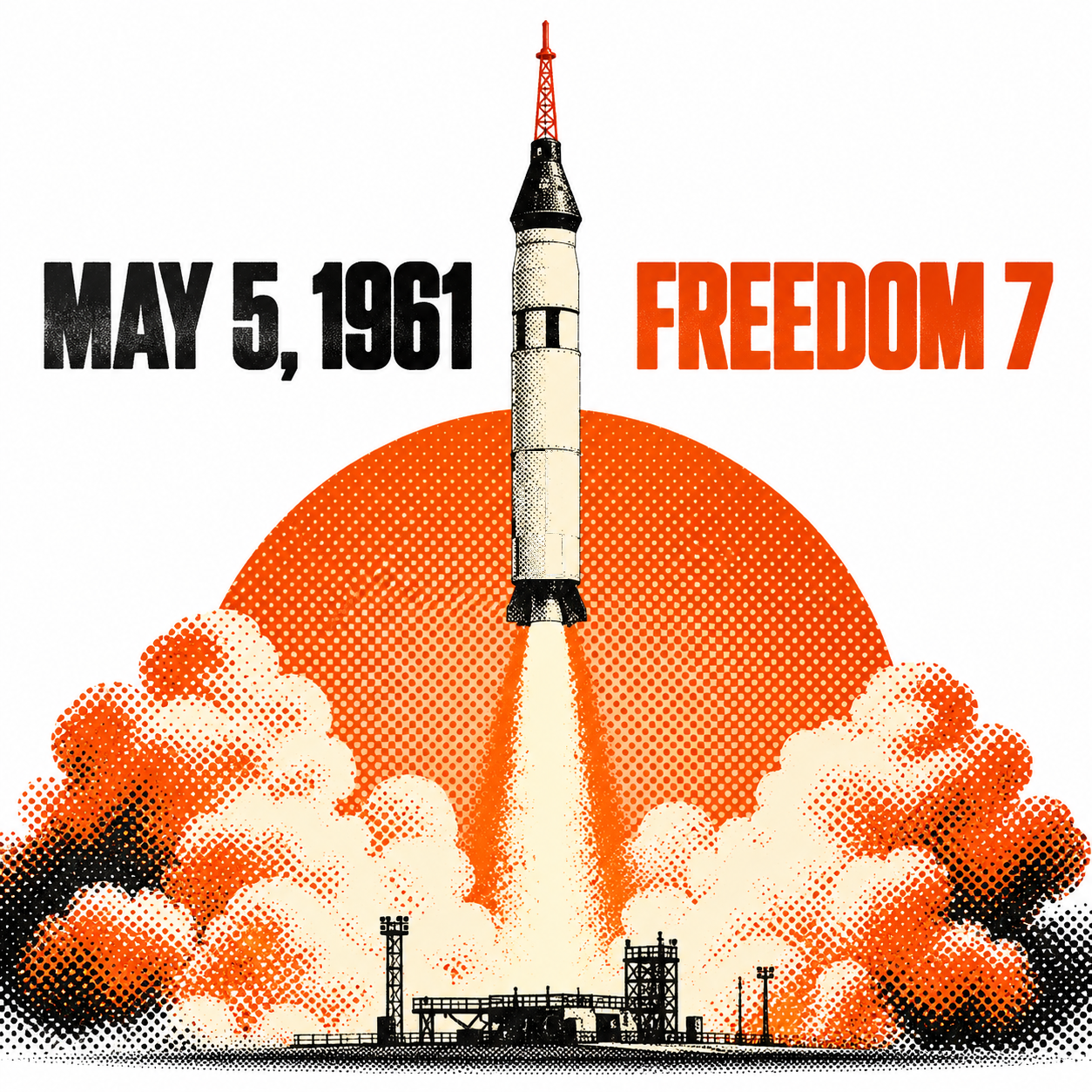
Fifteen minutes and twenty-eight seconds from Launch Complex 5.
Plate 07 · 5 May 1961 · Launch Complex 5, Cape Canaveral, Fla. · Mercury-Redstone 3 (Freedom 7) · 116.5 Miles Altitude · Source: NASA Historical Reference Collection
Alan Shepard’s first spaceflight lasted fifteen minutes and twenty-eight seconds, but the morning began with hours of waiting inside Freedom 7.
On 5 May 1961, the conical black Mercury spacecraft stood above a white Redstone LV-7 booster at Launch Complex 5, Cape Canaveral. Four cruciform fins marked the booster’s base. Below the spacecraft adapter, a black-and-white vertical roll-pattern band made the vehicle’s rotation visible to observers and cameras. A red open-lattice launch escape tower rose above the capsule, ready to pull it away from the booster in an emergency.
At 9:34 a.m. Eastern Daylight Time, the vehicle lifted off. NASA records the mission as Mercury-Redstone 3, with Freedom 7 as the spacecraft name. This was a suborbital flight, not a journey around Earth. The booster sent the capsule along an arc that reached 5,134 miles an hour and an apogee of 116.5 statute miles, about 187.5 kilometers.
During weightlessness, Shepard tested manual attitude control, using the spacecraft’s controls to change its orientation. Those minutes supplied evidence about what an astronaut could do in flight, rather than only what an automated system could accomplish. The capsule then returned through the atmosphere and descended beneath its parachute toward the Atlantic.
Splashdown came about 303 statute miles downrange, 15 minutes and 28 seconds after launch. The short duration is worth keeping exact, because the record includes ascent, weightlessness, reentry and recovery preparation inside that span. The familiar rocket silhouette belongs to that whole sequence, from a long wait on the pad to a small capsule in the ocean.